Shipping container modifications — what is safe to cut and what is not
Doors, windows, roller doors, lining, insulation, power and shelving: what can safely be cut into a shipping container, what carries load, and when to buy new.
Guide · 9 min read
Two people ring on the same morning, both after a 20ft. One is storing a restored motorbike and a rolling tool cabinet. The other wants somewhere to throw star pickets, poly pipe and a slasher that already lives out in the weather. Same size, same footprint, very different container — and a very different price.
Most people start with size. It feels like the decision that matters, because size is the thing you can picture sitting on the block. But size only tells us how much room you get. Grade tells us what condition the steel is in, whether the unit still keeps weather out, how long it has left, and how it will look sitting where you are going to put it.
Two units of the same length can sit a long way apart on price. Two suppliers quoting you on the same grade will usually land much closer together than that. So if you are comparing quotes and one is well under the others, the honest question is not who is cheaper — it is whether everyone is quoting the same grade.
There are three grades worth talking about in the Australian market. Everything else is a variation on one of them or a marketing word invented to sit between two.
A new container has been built, packed with cargo, shipped once, and unpacked at this end. That single loaded voyage is why the trade calls them single-trip rather than new. They arrive with factory paint, unmarked walls, a clean marine ply floor, and door gaskets that have not spent years being compressed and baked.
What you are buying is squareness and appearance. The doors swing and seal the way the factory set them. The floor has no history you have to guess at. The paint is one colour rather than the archaeology of three shipping lines. If the container is going somewhere people will look at it — a front yard, a shopfront, a display, a business frontage, a rural property where the owner has to live alongside it for twenty years — that matters more than it sounds.
It also matters if you intend to modify. Cutting a doorway or a window into a unit with straight walls and true corners is a far simpler job than cutting into one that has been knocked about, and the finished result closes properly. If a fit-out is the plan, start with straight steel.
Single-trip units are checked wind and watertight before they leave. The trade-off is cost and, occasionally, availability of a particular colour or door configuration.
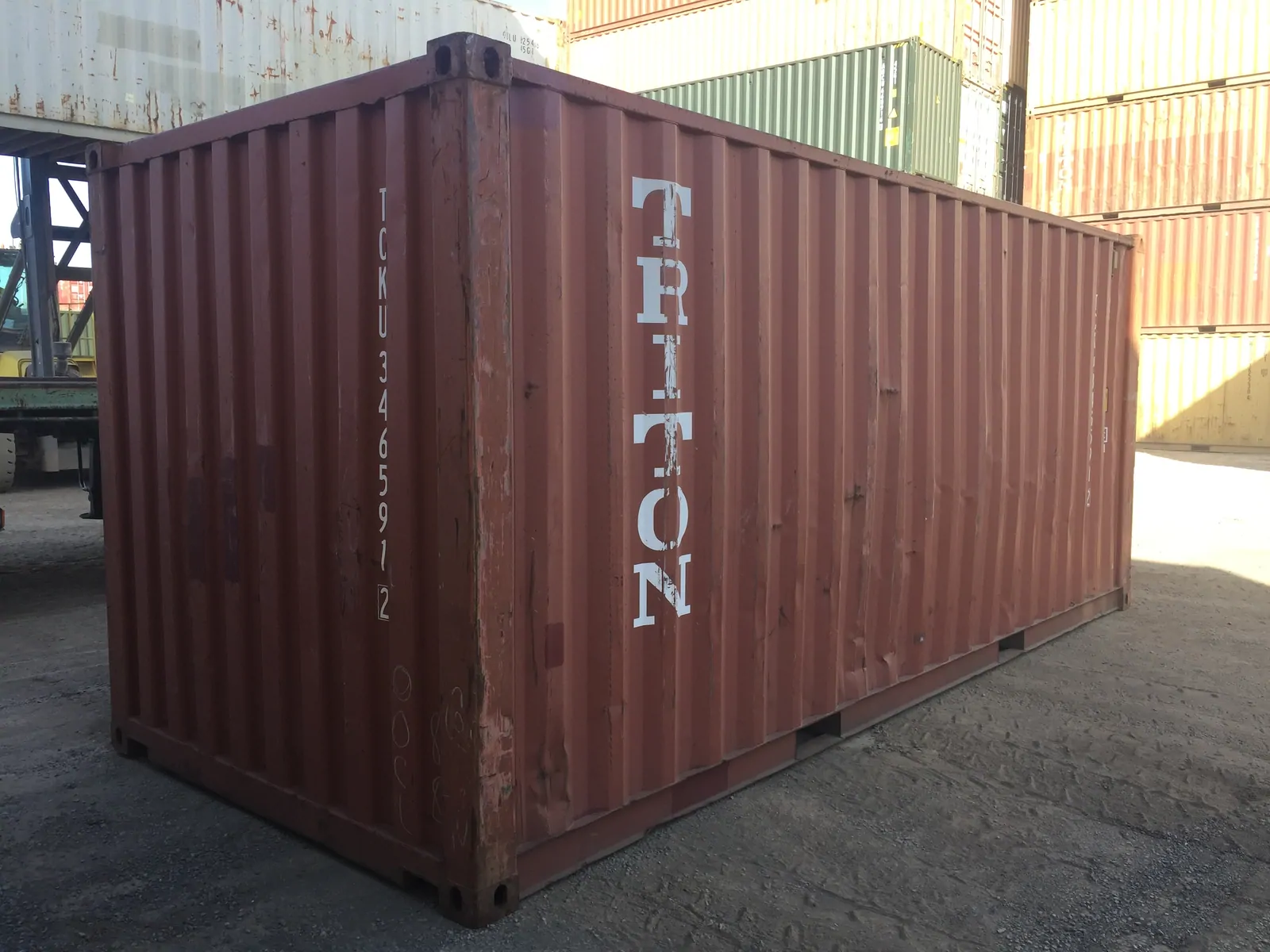
Cargo-worthy is a working container still certified fit to carry freight at sea. It is not a cosmetic grade and it does not pretend to be. Expect dents in the side panels, surface rust on the roof and rails, patchy paint, and the ghosts of old shipping line logos. Expect it to look like a thing that has done a job.
What you are buying is structural integrity. The corner castings, corner posts, top rails and bottom rails are sound. The floor carries load. The doors close, the locking bars seat, and the gaskets compress. Every cargo-worthy unit we sell is checked wind and watertight before it leaves the yard — that is what the grade is for.
This is the grade most buyers should be looking at. It is the sensible default for domestic storage, farm storage, trade lock-ups, site storage, dry goods, furniture, records, machinery and anything else that has to stay dry. It is also the grade that gets sold for hire, which is a decent indication of how much service life is left in one.
Because cargo-worthy covers a range rather than a point, condition varies within the grade. Two cargo-worthy 20fts on the same hardstand can look quite different. Ask which one you are getting, and ask for photographs of that unit on request and before delivery.
As-is is a container retired from sea service and sold on its faults. It is the cheapest grade by a distance and it is completely appropriate for a lot of jobs. It is also the grade people get wrong most often, because the word "cheap" arrives before the word "why".
As-is units are not sold watertight. An as-is container may carry a patched repair, a soft or delaminated section of floor, pinholes in the roof, or a door gasket that no longer seats. Any one of those will let water in, and roof pinholes in particular will drip onto whatever is directly below them for years before anyone notices.
That does not make the grade useless. It makes it specific. As-is works well as a lock-up under an existing roof or awning, a bund or containment shell, a base or frame for a build, a rubbish and scrap store, a shell for a modification where the walls are coming out anyway, or storage for things that already live outdoors — steel, pipe, fencing, formwork, drums.
What it does not work for is anything that must stay dry. Do not put documents, upholstery, tools you care about, electronics, feed, or stored household goods into an as-is unit and hope. The photographs we take of an as-is container show the faults on purpose, and we will tell you what is wrong with a particular unit rather than let you find out on delivery day.
Here is the counter-intuitive part. Going up a grade on the same size will usually cost you more than going up a size on the same grade.
The reason is that a container's price is mostly a function of its remaining service life and its saleability, not its steel content. A 40ft holds roughly twice the volume of a 20ft but does not cost twice as much, because the expensive parts — the doors, the castings, the certification, the handling, the yard space per unit — do not double. Look at the numbers on our 20ft and 40ft pages and the cost per cubic metre tells that story clearly.
Grade works the other way. A single-trip unit has its entire life ahead of it. A cargo-worthy unit has most of one. An as-is unit is being sold precisely because its remaining certified life has run out. You are buying time, and time is what people pay for.
The practical upshot: if the money is tight, dropping a size on the same grade is almost always a better decision than dropping a grade on the same size. A cargo-worthy 10ft that stays dry beats an as-is 20ft that does not.
| What is going in it | Sensible grade |
|---|---|
| Household goods, furniture, records, soft furnishings | Cargo-worthy or new |
| Tools, workshop gear, compressors, hand tools | Cargo-worthy |
| Feed, seed, hay, anything that spoils damp | Cargo-worthy or new |
| Site storage on a live job | Cargo-worthy, or hire |
| Steel, pipe, fencing, formwork, drums | As-is |
| Bund, shell, scrap store, base for a build | As-is |
| Visible from the street or a customer car park | New |
| Being cut for doors, windows or fit-out | New, or a good cargo-worthy |
Grade is a floor, not a full description. Within a grade you still want to know four things about the actual unit.
The container inspection page sets out what we check on a unit before it leaves, and what we will tell you about it.
Hire fleets sit at cargo-worthy or better, because a hire unit has to keep being acceptable to the next customer and the one after that. If you only need a container for a defined stretch — a build, a renovation, a harvest, a move — hire sidesteps the grade decision entirely. The trade-off is that you are paying for it for as long as it stands there. The terms and minimum periods are set out on the container hire page.
When you ring, the useful sentence is not "what does a 20ft cost". It is "I need to keep X dry for Y years, on a block that looks like Z". From that we can tell you which grade actually suits, whether a 10ft would do the job you have described, and what the unit will look like when it lands.
If a grade is not going to do what you want, we would rather say so on the phone than deliver it. Ring 0477 410 500, or send the details through the contact page. The full grade breakdown, size by size, sits on the container grades page.
More guides
Doors, windows, roller doors, lining, insulation, power and shelving: what can safely be cut into a shipping container, what carries load, and when to buy new.
How to secure a shipping container properly: lock boxes, the right padlock, where to point the doors, lighting and sight lines, and a realistic view of risk.
When shipping container hire makes sense and when buying does, how to find your own break-even, what to check in a hire agreement, and the cost of moving one.

Get a price
Ring us — 0477 410 500 — or send it through. Every enquiry answered within one business day.
Or skip the form and ring us — 0477 410 500, Mon–Fri 7:30am–5pm, Sat 8am–12pm