Container security — lock boxes, padlocks and siting the doors
How to secure a shipping container properly: lock boxes, the right padlock, where to point the doors, lighting and sight lines, and a realistic view of risk.
Guide · 9 min read
A container is a very good starting point for a workshop, a site office, a storeroom or a lock-up, and a bad one if you cut it in the wrong place. The frame is doing all the work and the panels are doing almost none. Knowing which is which is the difference between a modification and a repair bill.
Before any discussion of what to cut, understand what is holding the container up. It matters, because container structure is not intuitive.
The load path is: four corner castings, four corner posts, and the top and bottom rails that run the length and width between them. That frame carries the weight of the container, the weight of the contents, the forces of being lifted by the castings, and — in service — the weight of up to eight more loaded containers stacked on top.
The corrugated side and end panels carry very little vertical load. Their job is shear stiffness — stopping the rectangle from becoming a parallelogram — plus keeping weather out. The roof panel carries even less and is not designed to be walked on.
So the rule is simple and it does not bend:
Never cut, notch, drill through or weaken a corner casting, a corner post, or a top or bottom rail. Everything else is negotiable with the right framing.
Cut a rail and the container will still stand there looking fine. It will fail when it is lifted, and it will fail suddenly. A container with a compromised rail cannot be safely craned, which means it cannot be moved, which means it is now a permanent building whether you intended that or not.
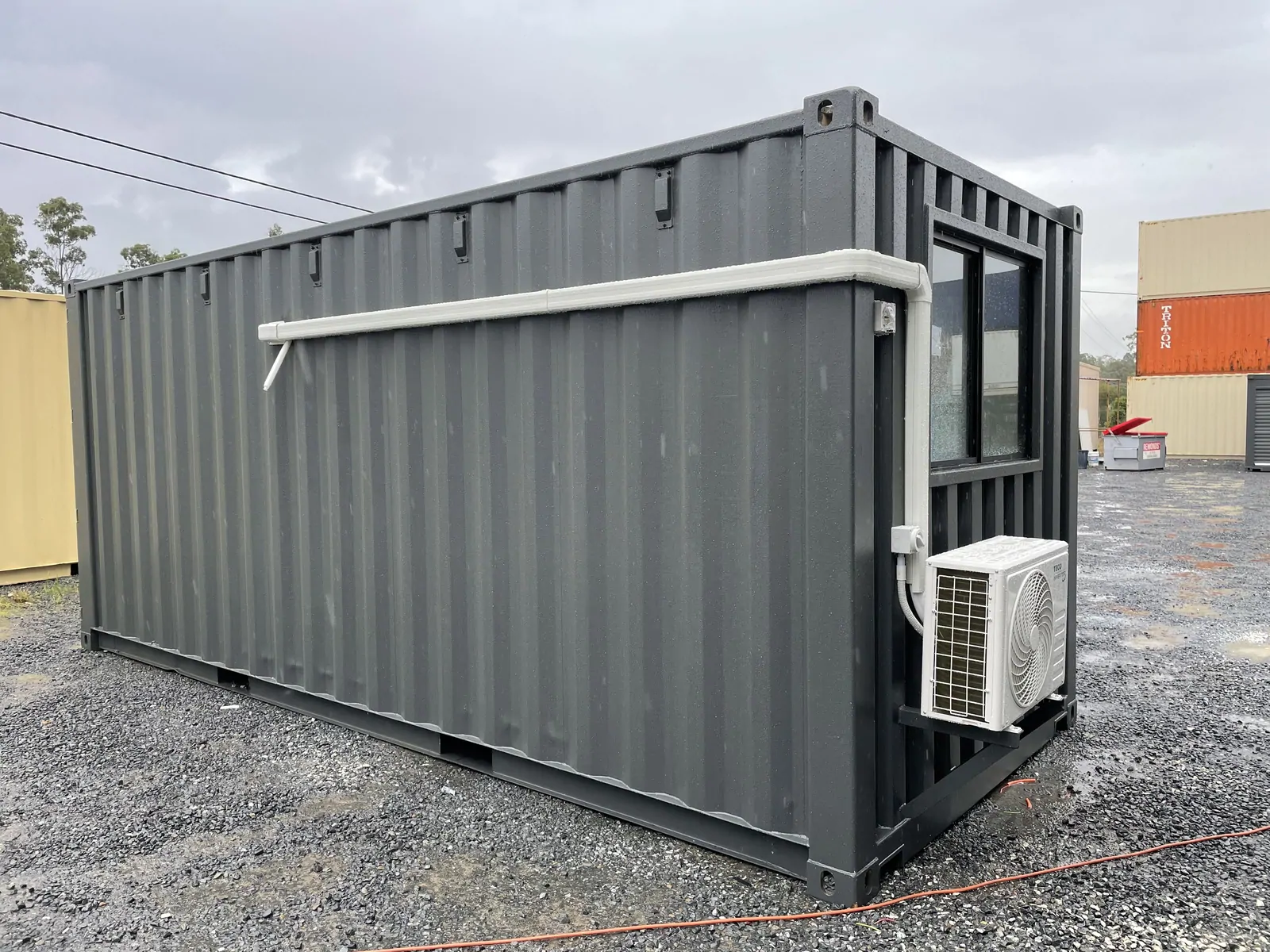
Panels can be cut, and cut generously, provided the opening is properly framed. Framing means welding steel — usually RHS or angle — around the full perimeter of the opening so the load path around it is restored and the panel is not left with a raw, flexing edge.
An unframed opening does three things, all bad. It lets the panel flex, which cracks the paint and then the steel at the corners of the cut. It removes shear stiffness, so the container can rack more easily. And it gives water a raw steel edge to sit on and start rusting.
Two practical rules from people who do this for a living: keep openings away from the corners, and keep the panel between multiple openings meaningful rather than a thin strip. A row of windows down one side with a hand's width of steel between them is a much bigger structural change than the same total opening in one place.
The most common request and the most useful. A standard steel door in a framed opening, usually in a side wall near one end. Being able to get into the container without swinging two large cargo doors changes how you use it daily.
Get one with a proper weather seal, and think about which way it swings and whether it will foul on shelving inside. Fit a lock that is not the weak point in the whole container — a good door with a builder's-grade latch is a wasted upgrade.
Straightforward in a framed opening. Consider security bars or a steel shutter, since a window is by definition the easiest way into the box. Consider condensation as well: a window in an uninsulated container is another cold surface, and it will run with water on the same nights everything else does.
Popular for workshops, gyms and anything you want to open wide daily. A roller door in a side wall gives you full-length access without a cargo door swing. It is a bigger structural intervention than a personnel door because the opening is large, so the framing matters more.
Be aware that a roller door will not seal like cargo doors. It is a weather-resistant opening, not a sealed one, and it is a lower security fitting than a lock box and a solid door. Fine for a workshop, less good for a store.
Whirlybirds, louvre vents and powered fans. Cheap and one of the highest-value modifications you can make, because it addresses the moisture problem that spoils more stored goods than leaks do. Roof penetrations must be properly flashed and sealed, or you have swapped condensation for a leak. Check what vents the unit already has before you start adding to them.
Insulation must be bonded to the steel with no air gap behind it. If air can move between the lining and the steel, condensation forms in the cavity where you cannot see it and rots the container from the inside. Closed-cell spray foam directly onto the steel is the most reliable answer. Batts in a stud frame against bare steel is the classic mistake.
Remember what lining costs you in space. Internal height on a general purpose container is 2.39 m, and a framed, insulated, lined ceiling can take 100 mm or more of that, plus the floor build-up. That is one of the strongest arguments for starting with a high cube, which gives you 2.69 m to play with and leaves a comfortable room rather than a low one. The full figures are on the dimensions page.
All electrical work must be done by a licensed electrician, without exception. In practice that means a switchboard, an RCD, external-grade cabling in conduit or trunking, LED battens, and either a lead-in for a plug-in supply or a hard-wired connection.
Two container-specific points. A steel box is a conductive enclosure and earthing matters — the container itself is bonded. And any penetration for a cable is a hole in a weatherproof shell, so glands and flashings need doing properly or you will find water tracking in along the cable.
Solar with a battery is worth considering for a remote or rural container, and it avoids trenching a supply out to a paddock.
The easiest modification and the one that most improves how the container works. Shelving can be bolted or welded to the side walls, and light shelving into the corrugations is fine. Do not fix anything into the corner posts.
Free-standing racking that does not touch the walls at all is often better again, because it is adjustable and it does not put holes in a weatherproof shell. Whatever you fit, do not brace shelving between opposite walls in a way that resists racking — the container is designed to flex a little and something rigid across it will tear its own fixings out.
Every container has lashing rings along the bottom rails and often the top. They are already engineered, already there, and generally strong enough for anything domestic. Use them before you weld new ones.
Whether a modified container needs approval depends on your council, the zone, how long the container is staying, whether it is habitable, and what it is being used for. A storage container on a rural block is usually a different conversation to a lined and powered office on a suburban block, and both are different again to anything with a bed in it.
We are not going to guess your council's position, and neither should anyone else selling you a container. Ring your local council and ask before the work is done rather than after. It is a ten minute phone call and the alternative can be an expensive one.
This is the decision that most often gets made backwards. People buy the cheapest unit they can find because it is going to be modified anyway, and then discover the modification costs more and finishes worse.
Buy new, or single-trip, when:
A good cargo-worthy unit is a perfectly reasonable base for simpler work — a personnel door, a vent, some shelving, a coat of paint. Where it stops making sense is a full fit-out. The trade-offs by grade are set out on the container grades page.
First, will this container ever need to move again? If yes, every decision has to preserve the frame and the castings, and that rules out a whole class of modification. If no, you have more freedom — but be honest, because "no" is a decision you are making on behalf of whoever owns the property next.
Second, is the container the right base at all? A container is superb value for a lock-up, a workshop, a store or a site office. Once you are into full insulation, plumbing, glazing and internal walls, you are building a building inside a steel box that is 2.35 m wide, and the width never changes.
Tell us what you are planning and we will tell you which size and grade to start from — and if a modification is a bad idea, we will say so before you buy the unit rather than after. Ring 0477 410 500 or use the contact page. The full range is on the containers page.
More guides
How to secure a shipping container properly: lock boxes, the right padlock, where to point the doors, lighting and sight lines, and a realistic view of risk.
When shipping container hire makes sense and when buying does, how to find your own break-even, what to check in a hire agreement, and the cost of moving one.
Why shipping containers sweat, why container rain wrecks more stored goods than leaks do, and what works: ventilation, insulation, desiccant and better loading.

Get a price
Ring us — 0477 410 500 — or send it through. Every enquiry answered within one business day.
Or skip the form and ring us — 0477 410 500, Mon–Fri 7:30am–5pm, Sat 8am–12pm